
Four Mile Ranch Golf Club: A Different Kind of Colorado Golf
By Bill Irwin
October 14th, 2026
Colorado has no shortage of golf destinations that announce themselves. Breckenridge, Vail, Colorado Springs and the Denver area all have courses familiar to traveling golfers. Cañon City, about 45 minutes southwest of Colorado Springs, is a different story.
The somewhat off-the-beaten-path town is a base for outdoor recreation, from rafting on the Arkansas River to hiking and mountain biking among the region’s red-rock canyons. Its historic downtown adds small-town Western character.
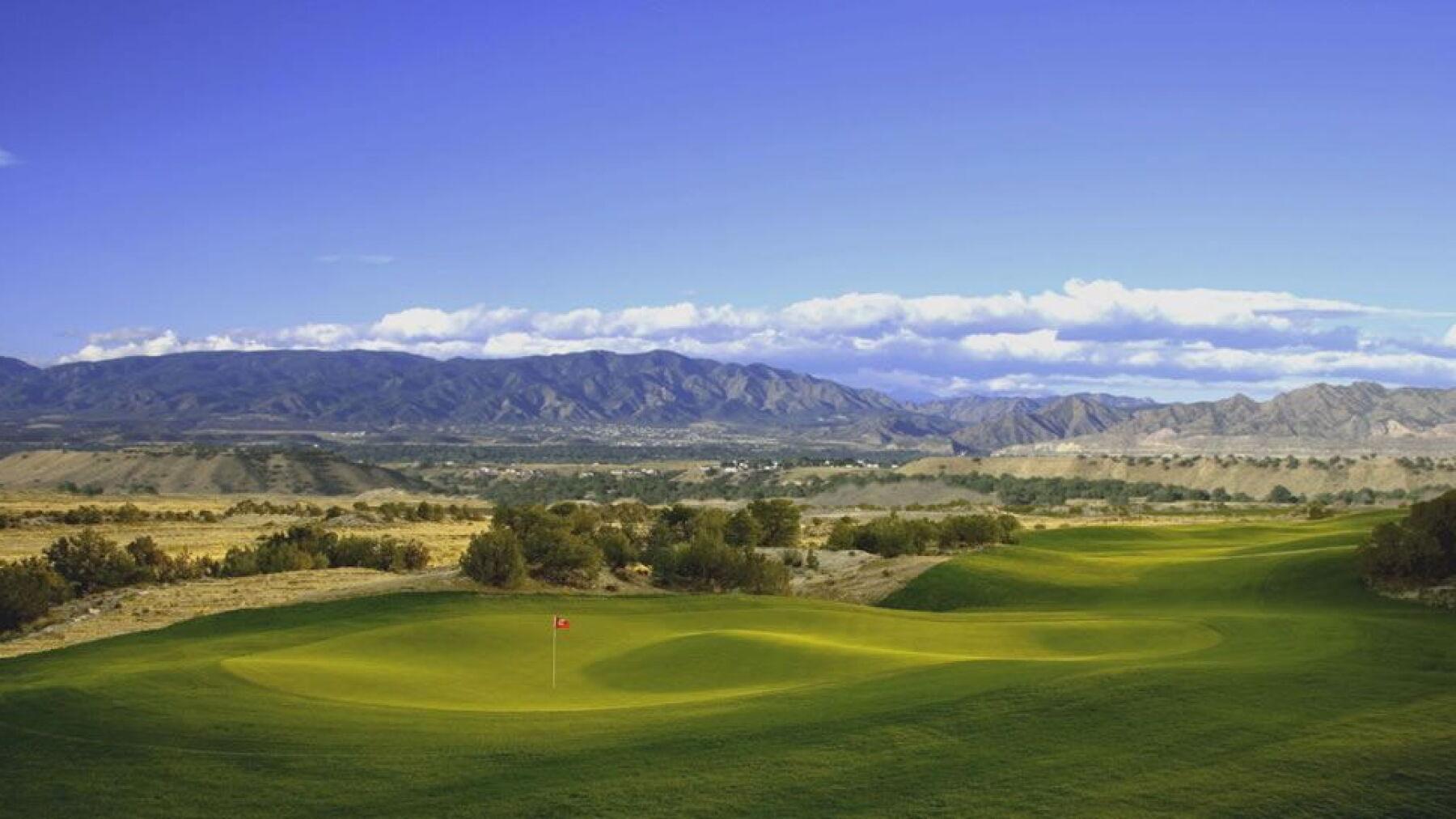
That sense of discovery carries over to golf at Four Mile Ranch Golf Club, a public 18-hole course that offers year-round play in Cañon City (the town calls itself the “Climate Capital of Colorado” for its mild winters and adundant sunshine). Tee times on GolfNow can often be found for well under $100. Mountains ring the property, but the better reason to play Four Mile is what happens at ground level, where shale takes the place of sand, targets disappear behind mounds, and the greens seem to have opinions of their own.
The first episode of GolfNow’s new Hidden Gems series on YouTube offers a good introduction to this 2008 Jim Engh design and what sets it apart from other Colorado courses. GolfNow Brand Ambassador Cailyn Whitmer and her husband, Tampa Bay Bucs QB coach Chandler Whitmer, play a match called Favored or Forsaken, with coin flips sending them to different sets of tees. Their friendly competition offers a revealing look at how the same landscape can present very different challenges.
Ranch ground with an architect’s imagination
“Driving up, you’re not sure what you’re getting into, and then all of a sudden you pull into this place and the views are insane,” Chandler says in the Hidden Gems episode.
Four Mile sits on a former working cattle ranch, and those origins help explain why it looks different from a conventional resort layout. The high desert landscape is irregular and exposed, with rock formations and changes in grade that interrupt sightlines and complicate otherwise straightforward-looking shots. The mountains frame the property, but the immediate landscape supplies much of the challenge.
Architect Jim Engh, a Colorado native whose notable in-state designs include Redlands Mesa and Fossil Trace, brought an expressive eye to that ground. His recognizable style favors bold shaping, unusual angles and a willingness to challenge golfers’ expectations. At Four Mile, that artistic streak has a practical outlet: shale mounds, obscured shots, punchbowl greens and slopes that make the terrain an active participant in the round. The quirkiness is not confined to appearances. It affects where golfers aim and what happens after the ball lands.
The ranch setting gives those features a coherent identity. Bare rock and native ground don’t feel like unrelated hazards dropped beside otherwise conventional holes. They belong to the same landscape as the fairways and greens. As Cailyn puts it, “You got mountains surrounding the entire course. It’s very western vibes out here.” The visual drama comes from the way the golf fits its surroundings, not just from the distant mountain backdrop.

One course, different challenges (and how to play a Favored or Forsaken match)
The Favored or Forsaken format makes an entertaining game out of a practical question: Which tees make the most sense for your game?
The game adds a few wrinkles to match play. The players alternate flipping a coin on each hole: Heads puts a player in the favored position, playing from the forward tees; tails leaves the player forsaken, playing from the tips. A birdie lets a player trump the flip and choose the forward tees instead. Winning a hole from the tips also earns a mulligan.
Four Mile plays nearly 2,400 yards longer from the tips than from the forward tees, and the Hidden Gems match shows how dramatically that difference can change the playing experience. The par-5 second, for example, measures 604 yards from the back and 428 from the forward tees. On the par-3 third, the difference is nearly as striking: 203 yards from the back tees versus 104 from the forward tees.
Altitude adds another variable. Four Mile sits in the high-desert landscape of southern Colorado at roughly a mile above sea level. Cailyn, who is from Florida, remarks that the ball flies farther for her in Colorado, a reminder that golfers visiting from lower elevations may find familiar yardages play differently.
Tee selection changes more than distance. It affects angles, landing areas and which parts of the terrain come into play. The club’s intermediate and combination tees give golfers plenty of options between the extremes, allowing them to choose a suitable overall length without facing every challenge from the same starting point.
For mixed groups, that flexibility is useful. At Four Mile, choosing a sensible set of markers can leave golfers better positioned to appreciate the design rather than simply struggle with its length.
No sand does not mean no trouble
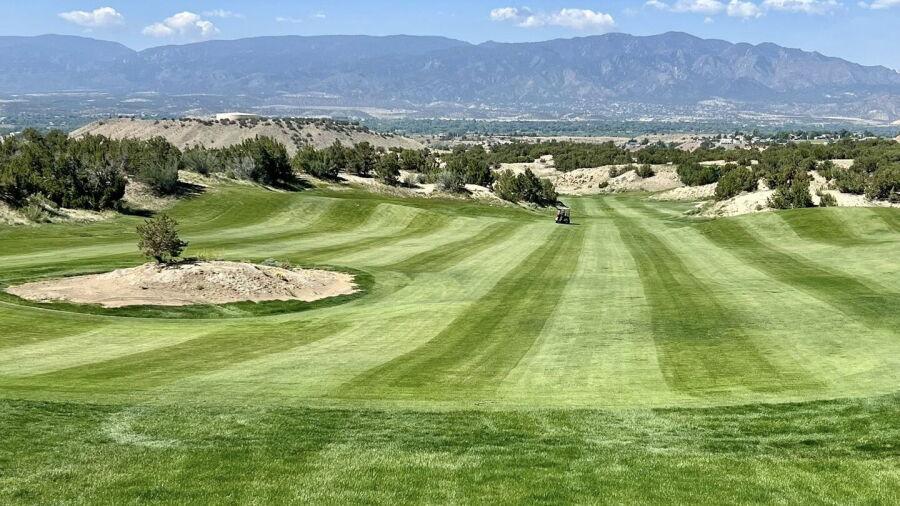
Four Mile’s lack of traditional sand bunkers is its most immediately recognizable distinction, but that doesn’t mean it lacks defenses. Shale formations and mounds do much of the work bunkers normally would, while blind shots, sharp doglegs and strongly contoured greens add their own demands. Native trees and scrub vegetation contribute to the rugged setting, and a barbed-wire fence can even become an obstacle during the round.
The Hidden Gems episode shows the difference early in the round. After Cailyn hits a wayward drive and figures she’s “off in a shrub,” Chandler locates her ball and quips, “Remember how they said there was no sand? You found the rocks at least.” For golfers accustomed to facing bunker shots, rocky lies at Four Mile present a less familiar problem—and no standard splash shot to fall back on.
A shot that looks safe from the tee may leave an awkward angle, while a miss can produce an uncomfortable lie among the rocks. The ground itself becomes the hazard.
The routing keeps changing the questions. A dogleg alters the preferred line from the tee; a ridge conceals a target; a mound interrupts the view of what lies beyond it. Golfers accustomed to seeing the entire assignment laid out in front of them may need a moment to get their bearings. The challenge Four Mile presents is not simply choosing a club for the distance, but understanding what the hole permits from the position they’ve reached.
Some stretches offer generous landing areas. Others reward placement over a rise to leave a manageable approach. Four Mile can invite an aggressive play, then ask for patience on the next shot. Its natural-looking defenses reward attention even when the fairway appears accommodating.
Greens that keep the ball working

If the shale catches the eye, the greens demand the most thought. Pronounced contours keep the ground involved long after an approach lands. Slopes can funnel a ball toward the hole, but they can also leave a tricky putt. Reaching the green doesn’t necessarily finish the hard work.
On an approach, aiming to one side of the target may be the smarter play, using a favorable slope to feed the ball toward the green. The same contours complicate putting, with breaks that can be difficult to read. Cailyn notes that some greens can feel like putting over a mountain. On Four Mile’s large, severely contoured greens, getting the ball in the hole can become a “putt and pray type situation.”
Worth the detour
Four Mile isn’t a resort course trying to manufacture a mountain-golf experience. It’s a public course shaped by former ranch land, with a design that embraces the property’s natural character. The shale isn’t decoration, and the absence of bunkers isn’t a gimmick. Blind shots, mounds, slopes and funneling greens all contribute to the same distinctive idea.
The scenery is certainly part of the appeal, but Four Mile offers more than a pretty mountain backdrop. Jim Engh’s unconventional design gives the course a personality of its own, rooted in the way the golf works with the land. The course can make a golfer stop and ask, What am I supposed to do here? That’s not a bad question to have on a golf course.
Cailyn Whitmer sums up the experience: “I truly loved playing here. It definitely is a hidden gem.” She acknowledges that Four Mile is “out in the middle of nowhere,” but says the views on arrival were “insane” and that the course “definitely exceeded both of our expectations.” She adds, “And the best thing is you can get it for under $100.” GolfNow Hot Deals can bring the price down a lot further.
For golfers willing to look beyond Colorado’s obvious stops, Four Mile Ranch Golf Club offers a different kind of mountain-country round—and a compelling reason to turn toward Cañon City.