
Ryder Cup Guide: History, Rules, and More
By Bill Irwin
No other golf event hits like the Ryder Cup. One of the world’s greatest sporting spectacles, it transcends sport. This biennial showdown between Europe and the United States tees off Friday, September 26, and wraps up Sunday, the 28th—and this year, the heat is cranked all the way up. The venue? Bethpage State Park’s Black Course, a gritty public Long Island layout known for its brutal design, unpredictable winds, and famously rowdy New York crowds ready to make their voices heard.
The Ryder Cup is golf’s most intense stage, where pride, pressure, and chaos collide. Whether you’re a diehard fan or just here for the spectacle, we’ve got you covered. This guide breaks down how the Cup works, how each team came together, and why the captains’ decisions can make or break the weekend. We’ll also dive into Ryder Cup history, spotlight the storylines driving the 2025 matches at Bethpage, and show why every shot feels like life or death. By the time the first tee shot flies, you’ll be ready for golf’s loudest, wildest weekend yet.
What Is the Ryder Cup and Why It Matters
The Ryder Cup is a team match-play competition between Europe and the United States played for the gold Ryder Cup trophy named after the event’s English founder, Samuel Ryder. It’s professional golf played for pride—not prize money (a bit more on that later). In a sport dominated by individual tournaments—where every player is out for themself—this flips the script. It’s totally team-focused and tribal. It’s intense. It’s history and legacy on the line.
There’s drama. There’s pressure. There’s no shrugging off a loss—players feel it in equal measure, because every point counts. The crowd roars, tempers flare, and each match result is magnified because you’re not just playing for yourself. You’re playing for the flag on your sleeve.
Sunday is the climax: twelve singles matches, winner-takes-all. Maybe this year we’ll get a gut-wrenching, nail-biting final-day finish. The last few Ryder Cups haven’t gone down to the wire—blowouts have dominated—but the format’s volatility means anything can happen. One clutch putt can flip everything.
This isn’t just another tournament. It’s golf’s rawest, most electrifying battleground, and this year, count on a frenzied New York crowd ramping it up even more.
Who Runs the Ryder Cup?
The Ryder Cup is co-owned by the PGA of America (owning the U.S. half) and Ryder Cup Europe (holding the European half). Ryder Cup Europe is an arm of the DP World Tour (formerly the European Tour) and its partners. While the event is a collaboration, each side independently manages its own team. Different systems, different vibes—but when the matches start, it’s all one high-stakes brawl for the Cup.
How Often Is the Ryder Cup Played?
The Ryder Cup tees off every two years, alternating between U.S. and European venues—a tradition dating back to the inaugural 1927 contest. What began as a friendly contest between the U.S. and Great Britain & Ireland quickly tilted one way: lopsided American dominance drained the matches of suspense and interest.
The fix came in 1979, when Continental Europe joined the party. That single change—fueled by legends like Seve Ballesteros, Nick Faldo, and Colin Montgomerie—supercharged the Cup into the fierce, can’t-miss showdown we know today.
Though it’s scheduled for every two years, there have been disruptions. World War II put it on pause for a decade. After 9/11, the 2001 event was pushed to 2002. And COVID bumped the 2020 Ryder Cup to 2021.
Still, the Ryder Cup remains one of golf’s most electric and enduring traditions—and now it’s less a tournament, more a gladiatorial turf war.
Ryder Cup vs. Presidents Cup
In Ryder Cup off-years, the Presidents Cup steps in. It’s another match-play showdown—Team USA vs. an International squad (minus Europe). Solid golf, sure, but it doesn’t pack the same punch.
The formats are mostly similar, but the Ryder Cup’s tribal pride and continental rivalry, plus its long history, just hit harder. Team USA has owned the Presidents Cup, and the International side is still chasing an identity. Competitive? Usually. Captivating like the Ryder Cup? Not even close.
Bethpage Black: New York’s Relentless Ryder Cup Star
The Black Course at Bethpage State Park is unlike any other Ryder Cup venue—it’s a gritty New York original. Built in the 1930s by A.W. Tillinghast, the Black is brutally long, with narrow, tree-lined fairways, thick rough, cavernous bunkers, firm greens, and unpredictable winds. Its infamous first-tee sign warns that it’s “extremely difficult” and meant only for “highly skilled golfers.”
Locals hardly need the reminder. They see it as their course—public, affordable, and a world away from the country-club aura of most U.S. Ryder Cup stops. When the U.S. Open came here in 2002, it was dubbed “The People’s Open.” This fall, it’s New York’s Ryder Cup.
Team USA captain Keegan Bradley knows it better than almost anyone. As a St. John’s University student, he logged countless rounds on the Black and still calls it his favorite course in the world. He understands how tough it plays—and how loud the crowd can get. That edge could matter.
Breaking Down the Ryder Cup Format
The Ryder Cup competition runs Friday through Sunday—a team-format golf match played in match-play style—hole by hole, not total score. Every hole is either won, lost, or tied. It doesn’t matter what you shoot overall—only whether you beat your opponent on that hole.
Friday & Saturday: Team Matches
Each day features two sessions (morning and afternoon), with four matches between two-man pairs—eight total per day. The formats alternate:
- Foursomes: Teammates alternate shots with the same ball. One takes tee shots on the odd numbered holes, the other on the even holes. It’s pure trust—one bad swing can sink you.
- Four-balls: Each player plays their own ball; the lowest score on the hole counts toward the team. Think bold, go-for-it golf.
Only eight players per team compete in each session, so captains must decide who plays, who rests, and when. The home team chooses the format order (foursomes or four-balls).
Sunday: Singles Showdown
All 12 players face off one-on-one. No subs, no hiding. Just you, your opponent head-to-head, and the pressure. This is where legends are made and heartbreaks hit hardest.
How Ryder Cup Scoring Really Works
There are 28 total points available:
- 16 from team matches (8 Friday, 8 Saturday)
- 12 from Sunday singles
Each match is worth one point. If a match is tied after 18 holes, the teams split the point.
To win the Ryder Cup, a team must reach 14½ points. If it ends 14–14, the team already holding the Cup keeps it.
Ryder Cup Match Play Rules
Every match is scored hole by hole. Win more holes than your opponent and you win the match. If it’s tied after 18 holes, the match ends as a tie. No playoffs, no extra holes — just 1/2 point for each side.
Players can concede putts—or even entire holes—and they often do. It’s part etiquette, part strategy, and part psychological gamesmanship.
Match Time: Who Plays, When, and Why It Matters
How those matches unfold depends on the captains. Some players might compete in all five sessions (two each on Friday and Saturday, plus Sunday singles), while others may sit out multiple times. The only mandatory round is Sunday singles. A player can earn up to five points, but most appear in three or four matches, depending on form, stamina, and strategy.
No Substitutions Allowed
Once pairings are submitted for four-balls or foursomes, they’re locked. If a player can’t go, the match is forfeited—no substitutions, no 2-vs-1. The opposing team gets the full point, no questions asked.
The Envelope Rule (singles only)
There is one exception—used only for Sunday singles. Before play begins, each captain secretly writes down one player’s name and seals it in an envelope. If an opponent can’t compete due to injury or illness, that player and the envelope pick both sit out. The match is considered tied, with ½ point going to each side.
The “Envelope Rule,” in place since 1979, has only been used three times (most recently in 1993). It’s a quirky safeguard every captain must keep in mind.
The Captain’s Role
Captains hold the reins. Before each session, they submit their lineups in secret, deciding who plays and in what order. Since neither side knows the other’s picks, every decision becomes a high-stakes strategic guessing game.
Pairings aren’t just about talent. Captains weigh form, personality, course fit, potential matchups, and team chemistry. One smart pairing can swing the momentum of an entire day.
During play, captains and assistant captains offer advice—extra sets of eyes and minds that can be crucial in clutch moments.
A captain can technically play, but only by taking one of the 12 roster spots; there’s no 13th-player loophole. Arnold Palmer was the last playing captain back in 1967. Nowadays, the captain’s planning and media obligations are so all-consuming that holding dual roles is almost unthinkable.
Yet for 2025, Keegan Bradley was squarely in the conversation to take the tee himself. He finished 11th in the automatic-qualification standings, and plenty of buzz swirled that he might use one of his six captain’s picks on himself. Instead, he made a bold and selfless choice: sit back, lead, and focus entirely on strategy and building team unity at Bethpage Black..
2025 Ryder Cup Captains — Keegan Bradley and Luke Donald
Keegan Bradley captains Team USA in 2025—a surprise to some, but an inspired choice to many. A major winner and fiery competitor, Bradley calls the Black Course his all-time favorite. He played in the 2012 and 2014 Cups (4-3 overall record) but was controversially left off the 2023 team. That snub still stings—and fuels him to this day. At 39, he’s the youngest U.S. captain in decades—relatable, intense, and likely to bring fresh, aggressive energy, especially at Bethpage State Park.
European team captain Luke Donald returns after his masterclass at the 2023 matches in Italy. The former world No. 1 is known for steady leadership and meticulous planning that inspires trust and confidence in his players. Donald’s calm, strategic style helped restore Europe’s unity after the team’s 2021 lopsided loss at Whistling Straits—and may be exactly what’s needed to navigate the chaos of a New York Ryder Cup.
The 2025 Ryder Cup Teams: Automatic Qualifiers and Captain’s Picks Set the Stage
With the showdown at Bethpage Black just days away, the full 12-player squads for Team USA and Team Europe are locked in. The qualifying drama is behind us, and the captains have finalized their picks. Now the spotlight shifts to the players who’ll carry the colors when the matches begin.
How Qualifying Worked — The Road to Bethpage
For both teams, six players punched their ticket by racking up the most Ryder Cup points over a long qualifying stretch. Points rewarded consistency across big events, with major championships and marquee tournaments carrying extra weight.
Team USA: Points were earned based on performance in the 2024 majors (plus the Players Championship) and the full 2025 PGA Tour schedule, excluding alternate-field events, through the BMW Championship on August 17.
Team Europe: Their qualifying window ran from August 29, 2024, to August 24, 2025, with points awarded in both DP World Tour and eligible PGA Tour events.
After the automatic qualifiers were set, captains Keegan Bradley and Luke Donald filled out their rosters with six captain’s picks each—balancing experience, current form, course fit, and team chemistry.
2025 Ryder Cup Rosters
Team USA
Captain: Keegan Bradley
Automatic qualifiers
- Scottie Scheffler
- J.J. Spaun
- Xander Schauffele
- Russell Henley
- Harris English
- Bryson DeChambeau
Captain’s picks
- Justin Thomas
- Collin Morikawa
- Ben Griffin
- Cameron Young
- Patrick Cantlay
- Sam Burns
Team Europe
Captain: Luke Donald
Automatic qualifiers
- Rory McIlroy (Northern Ireland)
- Robert MacIntyre (Scotland)
- Tommy Fleetwood (England)
- Justin Rose. (England)
- Rasmus Højgaard (Denmark)
- Tyrrell Hatton (England)
Captain’s picks:
- Shane Lowry (Ireland)
- Jon Rahm (Spain)
- Sepp Straka (Austria)
- Viktor Hovland (Norway)
- Ludvig Åberg (Sweden)
- Matt Fitzpatrick (England)
Did Any LIV Golfers Make the Teams?
Short answer: yes. LIV Golf players can make the Ryder Cup if they accumulate enough points or earn a captain’s pick.
Team USA: The odds were steep—most LIV members don’t play enough PGA Tour events to generate significant points. But Bryson DeChambeau cracked the code, thanks to his 2025 U.S. Open win and strong performances in other majors, earning an automatic spot. He’s the only LIV player on the U.S. side this year. (By comparison, Brooks Koepka made the 2023 U.S. team as a captain’s pick, but Bradley opted not to select any LIV players this time.)
Team Europe: The points system is more accessible for LIV members because DP World Tour events count, provided they maintain membership. Tyrrell Hatton took full advantage, becoming the first European LIV golfer to qualify outright. Jon Rahm also made the team as a captain’s pick, bringing his signature intensity and Ryder Cup experience back to Europe’s lineup.
Are Ryder Cup Players and Captains Paid?
Team Europe competes purely for pride—always has. Players receive travel, lodging, and team gear, but no personal pay. Representing Europe remains the ultimate honor.
Team USA’s approach is more complicated—and changed in 2025. For the first time, each U.S. player and the captain receives $500,000 total: $300,000 goes to charity, as it has since 1999, while a new $200,000 stipend is paid directly to them.
The PGA of America says the change addresses long-standing concerns among some U.S. players. Still, it sets up a sharp contrast: one side plays purely for continental pride, the other also collects a paycheck. Americans may insist it’s not about the money, but Euros—and fans—might see it differently.
Ryder Cup History, Headed for Bethpage
As Bethpage State Park welcomes the 2025 Ryder Cup, it’s about to add a new chapter to the history of one of the world’s greatest sporting events. That story began in 1927 at Worcester Country Club in Massachusetts, where the first official matches were held. It didn’t go well for the British professionals—Team USA crushed them 9½ to 2½.
Among past Ryder Cup venues, The Belfry’s Barbazon Course stands out, hosting a record four times. No U.S. course has hosted more than once, and until now, every American venue has been a private club or luxury resort. The Cup didn’t travel to continental Europe until 1997, when Spain’s Real Club Valderrama played host. Europe won that year, a defining moment for Seve Ballesteros, who captained the home side to victory.
For much of its early history, the Ryder Cup was defined by sportsmanship—none more iconic than 1969 at Royal Birkdale, when Jack Nicklaus famously conceded a short putt to Britain’s Tony Jacklin on the final green with the entire competition hanging in the balance. Had Jacklin missed, the U.S. would’ve won. Instead, the matches ended in a tie, giving birth to one of golf’s most enduring moments: The Concession.
Since then, the tone has sharpened. The rivalry grew louder and edgier, nowhere more apparent than in 1991 at Kiawah Island’s Ocean Course—The War on the Shore. Fueled by gamesmanship claims, rules disputes, and lineup drama, the tension was sky-high. The U.S., sporting military-style outfits and channeling Desert Storm vibes, edged Europe by a single point.
What kind of energy will Bethpage deliver? That remains to be seen—but if history is any guide, expect this New York showdown to unleash grit, noise, passion, and incredible golf in equal measure.
Who Won the Last Ryder Cup? — Europe’s Roman Roar
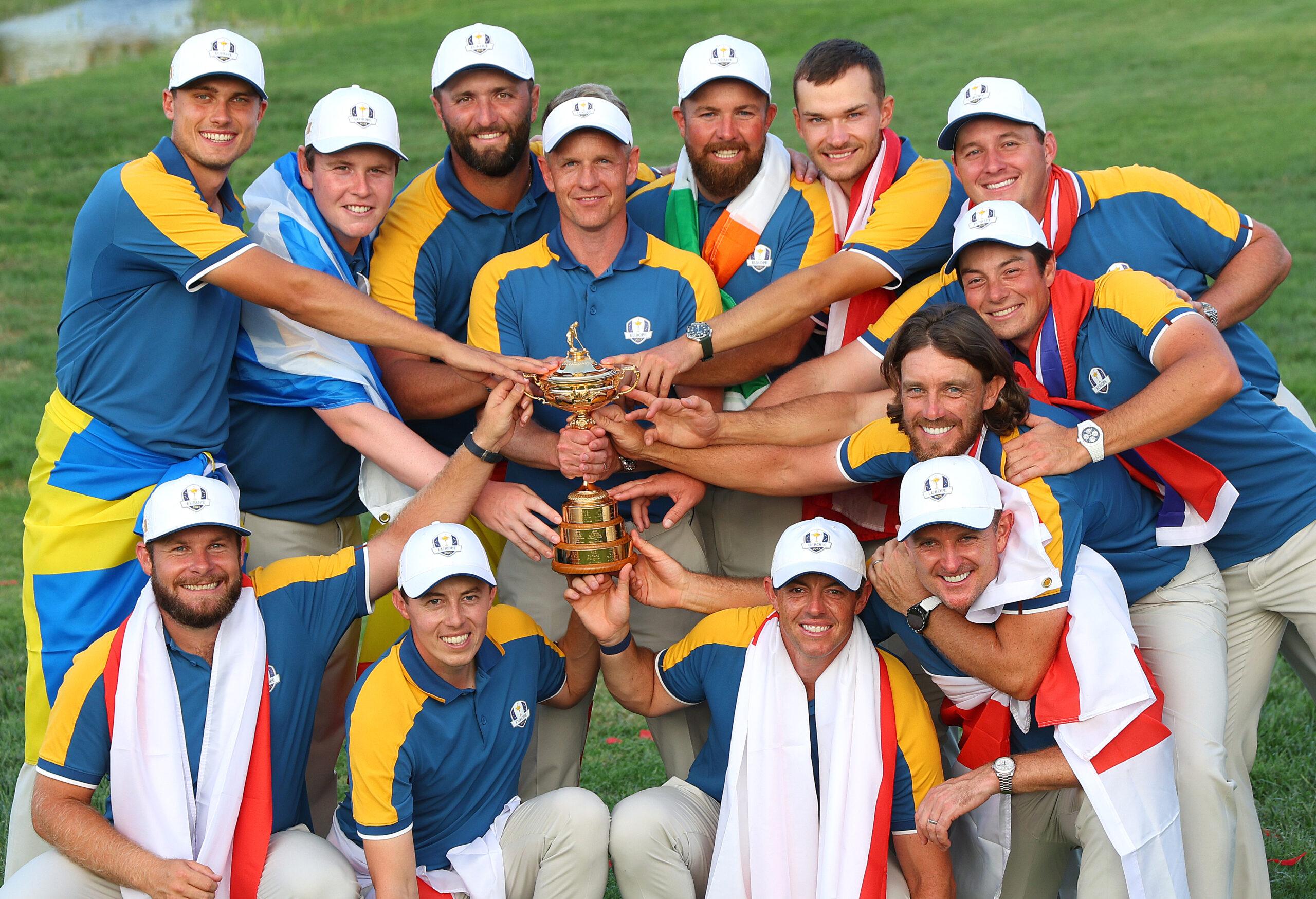
Europe dominated in 2023, winning 16½ to 11½ at Marco Simone Golf Club outside Rome—the first Ryder Cup ever held in Italy. Rory McIlroy, Viktor Hovland, Tyrrell Hatton, and Jon Rahm set the tone with clutch play and fierce intensity. The American team never found its footing. Scottie Scheffler was even reduced to tears after a brutal 9&7 foursomes loss.
Things got spicy on Saturday. Patrick Cantlay, reportedly frustrated over the no-pay policy, ditched his U.S. team cap—fueling “pay protest” chants from European fans. After Cantlay sank a putt on 18, his caddie Joe LaCava lingered in celebration, visibly irritating McIlroy. Emotions were already high on that hole—and they soon boiled over. Minutes later, McIlroy got into a heated exchange in the parking lot with caddie Jim “Bones” Mackay—an encounter that instantly went viral.
With the Black Course at Bethpage—and its famously rowdy New York fans—set to host in September, the only question is: how much hotter will the cauldron burn this time?
Players to keep an eye on at this year’s Ryder Cup
Every Ryder Cup carries its own mix of reliable veterans, wide-eyed newcomers, streaking stars, unpredictable characters, and a few question marks. With Bethpage set to host, here’s how the cast of contenders breaks down.
The Stalwarts
Experience counts, especially in Ryder Cup battles. Veterans like Rory McIlroy, Jon Rahm, and Viktor Hovland for Team Europe, and Scottie Scheffler, Patrick Cantlay, and Justin Thomas for the U.S. bring the clutch gene, fire as well as icy calm, and a history of Ryder Cup success. When the pressure mounts, these anchors steady the ship and inspire their teammates.
The Rookies
Stepping into the Ryder Cup for the first time is unlike any other test in golf. This year, the U.S. brings four newcomers:
- Russell Henley – The oldest member of the team is hardly a bomber, but his precise approach play and pure putting stand up to anyone. His impressive record at the 2024 Presidents Cup shows he can deliver in pressure situations.
- J.J. Spaun – A journeyman turned major champion, Spaun shook off his near miss at the Players Championship by capturing the 2025 U.S. Open. Steady ball striking and streaky putting make him a dangerous weapon.
- Cameron Young – A Long Island native with prodigious length and a consistent all-round game, Young broke into the winner’s column at the 2025 Wyndham Championship after a string of runner-up finishes. Always solid and often spectacular, he’ll have the New York crowd behind him.
- Ben Griffin – One of the breakout stars of 2025, Griffin scored his first two Tour wins and nearly added a third at the just-completed Procure Championship. Strong putting and the ability to string birdies in bunches are his calling cards.
Team Europe boasts a proven veteran lineup with just one rookie.
- Rasmus Højgaard – The 24-year old Dane used a strong showing late in 2024 and a burst of fine play late this year to earn automatic qualification. He’s a big hitter with a finesse game and he has Ryder Cup bloodlines — his identical twin brother was a Euro team member in 2023.
Hot Right Now
Momentum matters. Some players arrive in peak form, and that can flip matches in an instant.
- Scottie Scheffler – It seems like he wins every week. The world’s clear-cut no. 1 player, Scheffler is scary steady, can execute any shot when needed, and thrives in match play.
- Sam Burns — Best friends with Scheffler, Burns might have won this year’s U.S. Open had he gotten a favorable ruling. He’s an elite putter and a proven match-play winner.
- Justin Rose – At 45, Rose is still producing big results, finishing runner-up in a playoff to McIlroy at the Masters and winning the FedEx St. Jude Championship. He’s turned back the clock, but his success usually boils down to his putting.
- Tommy Fleetwood – After numerous agonizingly close calls, the popular Englishman finally captured his first PGA Tour win at the TOUR Championship. His Ryder Cup record, especially in foursomes (4-0), is sterling. Fleetwood’s form from tee to green is dynamic. If his putter is working, watch out.
Tyrrell Hatton
The fiery 33-year-old Englishman deserves his own spotlight. Now a four-time Ryder Cupper, he’s qualified automatically for all the matches since 2018. In Rome he went undefeated (3.5-.5). Whether he’s muttering to himself, slapping his putter, or flashing a bemused grin, he’s sure to be one of the most fascinating watches at Bethpage.
The Question Marks
Every Ryder Cup features prominent figures surrounded by uncertainty.
- Jon Rahm – The Spaniard arrives as the 2025 LIV Golf Individual Champion despite not winning a tournament. His form has been solid but short of his usual brilliance, leaving doubts about whether he can summon the fire that has defined his past Ryder Cup performances.
- Xander Schauffele — Normally a U.S. rock, he has endured a lost 2025 season. Injuries derailed his momentum after winning two majors in 2024, and with only two top 10s all year, it’s fair to wonder if he can rediscover his form in the Ryder Cup spotlight.
- Bryson DeChambeau – The role golf’s “mad scientist” will play at Bethpage is an open question. A true eccentric, the LIV Golf star has earned a reputation in previous Ryder Cups as a difficult partner. How he fits into this team—and whether the added outsider pressure will inspire or unsettle him—remains to be seen.
- Keegan Bradley – The U.S. captain faces a unique challenge. By passing on the added burden of playing, he put full focus on leading—but the Europeans are quietly questioning whether his youth and inexperience can withstand the Ryder Cup cauldron. The pressure on America’s youngest captain in decades is palpable.
Can You Still Get A Ticket? Here’s the Real Price of Admission
Tickets for the 2025 Ryder Cup at Bethpage Black went on sale in November 2024—and sold out fast, even at sky-high prices. Here’s what the PGA of America originally charged:
- Tuesday & Wednesday practice days: $255 each
- Thursday (Final practice + Opening ceremony): $424
- Competition days (Friday–Sunday): $750/day (includes unlimited food and non-alcoholic drinks)
For comparison, a 2025 Masters competition-round ticket (via lottery) cost just $140.
Want In? What it costs now
Yes, you can still get in, but expect to pay a hefty premium. Tickets are officially gone, and the Ryder Cup website sends fans to SeatGeek, the event’s exclusive resale partner. Resale prices for each competition day routinely top $1,200, with steep fees on top. Official “packages” remain, but only for those willing to pay luxury prices.
Who’s in the crowd?
With these prices, corporate groups, high-rollers, and plenty of bucket-listers will be thick on the fairways. Fans who shell out four-figure sums for a ticket will arrive primed to be part of the scene—and will feel entitled to make themselves heard. Expect a lively, fanatical, unapologetically raucous Bethpage Black crowd, where the price of admission guarantees raw passion—and unpredictability, too.
What Will the Trump Effect Be?
President Donald Trump plans to hit Bethpage Black on Friday, September 26. Unlike his recent appearance at the US Open men’s tennis final—officially delayed 50 minutes and played in front of a half-empty stadium that didn’t fill until the second set—Ryder Cup organizers insist the matches will start on time. Security will be paramount. Getting 60,000+ fans through TSA-style screening is a massive challenge—especially since Bethpage will host more than twice the crowd that endured that mess at Flushing Meadows.
Organizers are nudging the President to arrive after lunch to help the crowd settle, avoid bottlenecks, and let the opening holes breathe. Surely he wants to be present for the first-tee frenzy as the competition begins! If that happens, bedlam is inevitable. Either way, Bethpage Black is primed for seismic energy—a sure bet when Donald Trump and the Ryder Cup collide.
Bring on the 2025 Ryder Cup
If you’re not already fired up for the Ryder Cup, just wait for the first tee shot. This is must-watch golf—arguably the most electric event in the sport, maybe in all of sports. From the intensity of match play on the Black Course—one of the game’s toughest tests—to the teams’ chemistry and fierce rivalry, and the wildly passionate New York crowd, everything is dialed up to eleven. Pride, history, and legacy are on the line. Every point feels like life or death.
Get ready for three unforgettable, fever-pitched days of golf. Expect roars, pressure, and pure adrenaline as the Black Course becomes a cauldron of chaos and brilliance. The 2025 Ryder Cup is here—and it’s ready to blow the roof off.